
PERSISTENT ATRIAL FIBRILLATION: SUBSTRATE TARGETED STRATEGY

Coordinator: Prof. Univ. Dr. Radu Vatasescu
Team SCUB
- Prof. Dr. Radu Vatasescu – coordinator of the SCUB research team
- Dr. Laura Stanciulescu – PhD student
- Dr. Gabriela Marascu – PhD student
- Ing. Viviana Gondos – medical engineer, CARTO tehnical support
- Dr. Miruna Micheu – responsible for administrative issues
The clinical activity within the project is also supported by the rest of the cardiac electrophysiology team: Dr. Corneliu Iorgulescu and Dr. Alexandru Deaconu.
Additional information regarding the project:
SUMMARY

Atrial fibrillation (AF) is a common condition affecting over 10 million patients in Europe. It is caused by alterations in the atrial substrate, which disrupt the normal flow of electrical impulses and lead to atrial conduction disturbances. AF increases the risk of stroke, mortality, and reduces quality of life. Medications or ablation procedures aimed at restoring sinus rhythm have limited success, with 30-50% of patients still experiencing AF. This is because current treatments focus on electrical abnormalities, rather than addressing the underlying fibrotic substrate.
Women and patients with cardiovascular comorbidities are more likely to have extensive changes in the atrial substrate, respond poorly to therapy, and experience more complications from drugs and interventions. Therefore, a one-size-fits-all treatment approach is not effective for AF. There is also a lack of consensus on the best way to assess the AF substrate, making it difficult to standardize treatment strategies.
The PERSUADE project is currently under development within the Clinical Electrophysiology and Cardiac Pacing Laboratory of the Bucharest Emergency Clinical Hospital. This is a research project focused on the integration of large-scale data models (cardiovascular multimodal imaging, ECG, intracardiac electrograms [EGM]) is underway, starting January 1, 2024, to identify the critical pathophysiological mechanisms underlying persistent atrial fibrillation, to understand the failure of ablative therapy and to identify patients who could benefit from a more extensive ablation from the first procedure.
The study is a multicenter, prospective one, developed in collaboration with a series of international partners: "Puerta del Mar" Cadiz University Hospital (Spain), Amsterdam University Medical Centers (Netherlands), the Polytechnic Institute of Milan (Italy) and the University of Valencia (Spain).
To address these challenges, the consortium aims to improve rhythm control therapy for AF by better understanding the differences in the atrial fibrotic substrate between men and women, and patients with and without cardiovascular comorbidities. Parameters such as conduction velocity, functional mapping, surface ECG, and markers from cardiac CT scans can provide a deeper understanding of the arrhythmogenic substrate and guide treatment based on catheter ablation. In addition, computer models and machine learning techniques can be used to explore underlying mechanisms and predict the prognosis of patients undergoing AF treatment. The ultimate goal is to automate treatment strategies and improve outcomes for AF patients through a better understanding of fibrosis formation and its underlying mechanisms.
RESULTS
Between December 2024 and December 2025, the enrollment of eligible patients in the study continued based on the inclusion and exclusion criteria previously established, and all requirements necessary for pre-procedural preparation were completed. The consumable materials required for carrying out the activities were acquired. At the end of October 2025, patient enrollment in the study was finalized. A total of 17 patients were included. Intraprocedural images were recorded in the CARTO 3D system, and the target electrograms were annotated according to the acquisition protocol. Subsequently, patients were periodically followed up according to the protocol developed in Stage 1.
1. Enrollment of eligible patients and periodic follow-up
For patient enrollment in the study, the following activities were carried out:
- verification of eligibility criteria (inclusion and exclusion);
- signing of informed consent;
- complete pre-procedural evaluation through cardiac angio-CT imaging and transthoracic echocardiographic assessment;
- completion of data collection forms (patient records and evaluation forms attached in the Annexes);
- patient monitoring by 24-hour Holter ECG and transthoracic echocardiography at 3, 6, and 12 months post-procedurally.
2. Definition and annotation of target electrograms; substrate-specific ablation
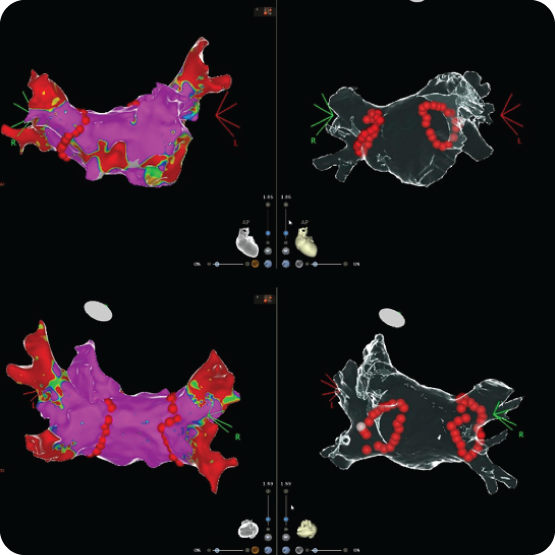
This was performed intraprocedurally through the analysis of atrial electrograms in sinus rhythm, after the application of three extrastimuli calculated according to the atrial effective refractory period.
During the procedure, several types of electrophysiological maps were created, depending on the cardiac rhythm: atrial fibrillation, sinus rhythm, or paced rhythm after the administration of three extrastimuli. In addition, the points manually collected during mapping were marked with specific labels indicating the type of observed signal: fragmented potentials, double potentials, as well as positive or negative responses to atrial extrastimuli.
Considering the difficulties encountered by some consortium partners in obtaining ethics committee approval, the study inclusion period was extended until the end of October 2025, with substrate-specific ablation scheduled to begin in November 2025 in all participating centers.
3. Development of the secure project platform
The obtained data were stored using a secure platform, which enabled data exchange with the study partners.
4. Acquisition of consumable materials
All consumable materials necessary for carrying out the second stage were acquired, in accordance with the current protocol.
DISSEMINATION
- Scientific article: G‑E. Marascu, A.I. Deaconu, R‑E. Mitran, L.A. Stanciulescu, R.G. Vatasescu, “Targeting the Substrate: Mechanism-Based Ablation Strategies for Persistent Atrial Fibrillation”, Journal of Clinical Medicine, Volume 14, Issue 14, 2025. https://doi.org/10.3390/jcm14145147
- Oral presentation: R.G. Vatasescu, “Modern rhythm control strategies in atrial fibrillation: who, when, and how”, National Congress of Cardiology, 64th Edition, Sinaia, September 17–20, 2025.
- Oral presentation: R.G. Vatasescu, “Current updates in ablation strategies for persistent atrial fibrillation”, National Congress of Cardiology, 64th Edition, Sinaia, September 17–20, 2025.
- Oral presentation: Etel Silva, PERSUADE Project presentation, CARDINNOV Call – Mid-term Symposium, Agence Nationale de la Recherche, Paris, France, October 20–21, 2025.
- Open-access platform: “Atrial fibrillation models and simulations personalized to substrate-specific data”, Duna Luis Moura, Miguel Rodrigo, Juan Fernandez-Armenta, Etel Silva Garcia, Radu-Gabriel Vatasescu, Gabriela-Elena Marascu. https://doi.org/10.5281/zenodo.17432339